Inside the Austin-Area Fusion Centers: What They Are, Who Runs Them
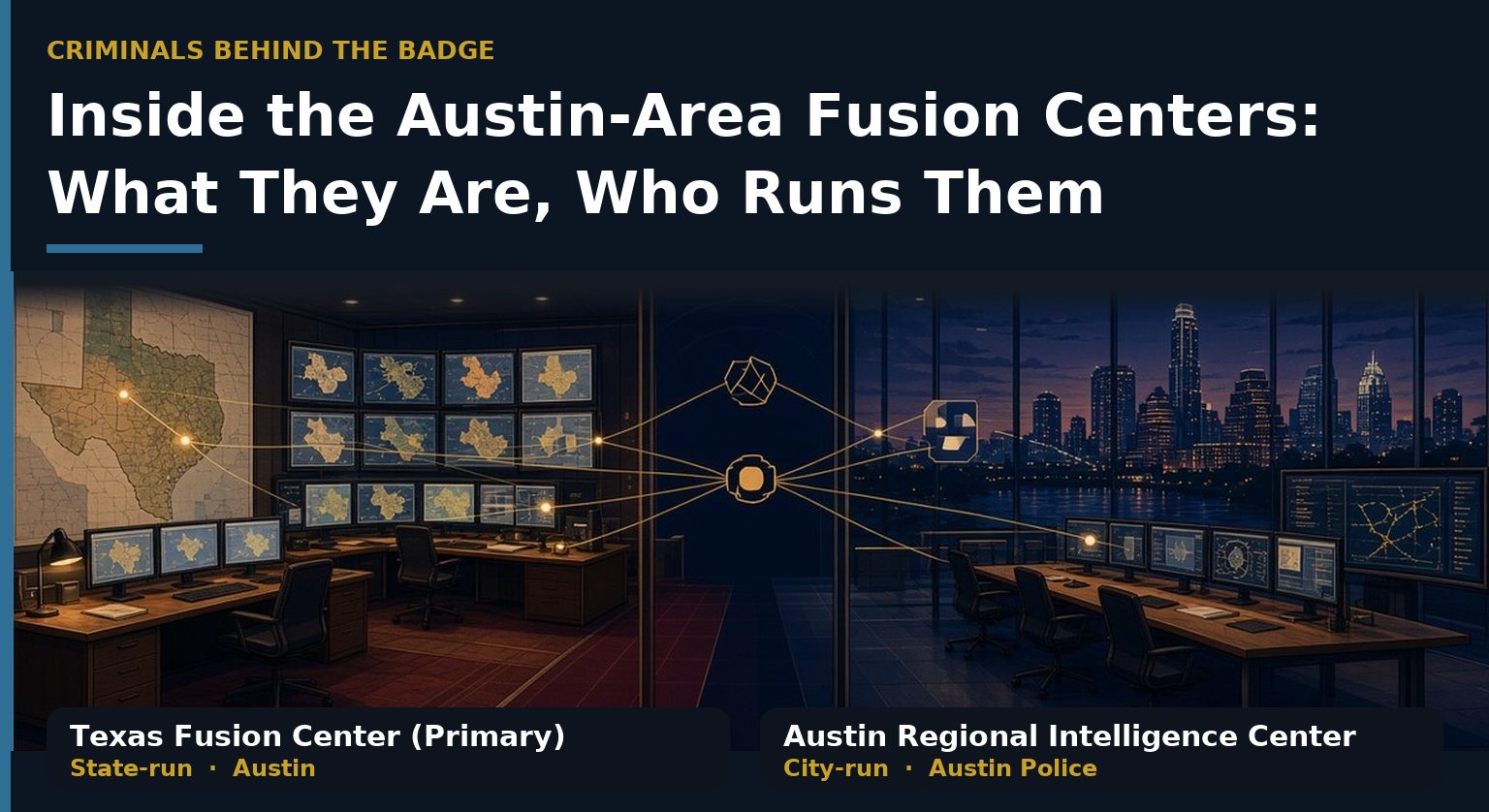
Two recognized fusion centers serve the Austin region — the state-run Texas Fusion Center and the city-run Austin Regional Intelligence Center. Here's how they're built and which federal partners plug into them.
A fusion center is a knot of law enforcement agencies sharing intelligence under one roof. Defined by the Department of Homeland Security, each fusion center collects, analyzes, and disseminates threat and criminal information among federal, state, and local partners rather than keeping each agency's reports in its own silo. Texas maintains a national network of roughly eighty of those hubs; two of them sit in the Austin area.
The first: the Texas Fusion Center (Primary)
The Texas Fusion Center is the flagship state-level hub, run out of Austin as part of homeland-security infrastructure. It serves as the state's repository and evaluates threats with statewide reach, offering the primary point of contact for its region. A state contact number for it is listed publicly at 512-424-7981, with the national line 866-786-5972.
Because it is a primary center, it anchors the state's participation in the national fusion network — the data it reviews flows up to federal partners and back down as alerts to local agencies.
The second: the Austin Regional Intelligence Center (ARIC)
The ARIC is recognized by DHS as a regional fusion center, with the Austin Police Department staffed as its lead agency. According to Austin's own police overview, the ARIC provides a centralized, multi-agency criminal information stream to local and regional partners. A contact number for it is listed at 512-974-2742.
The ARIC has drawn strong public scrutiny from civil-liberties groups, who argue its surveillance and information-sharing setup puts vulnerable residents at risk; advocates have filed against ARIC's role in federal immigration enforcement among other uses.
Who plugs into them
A fusion center does not equal any one agency, which is exactly the point: the federal partners who staff it typically include the FBI (counterterrorism and criminal-threat analysis), ICE's Homeland Security Investigations (immigration and worksite investigations), and the U.S. Marshals Service (fugitive operations), alongside the local sheriffs and police departments whose street-level reports feed the center in the first place.
That mix is the fusion design: a tip or a complaint made to a local deputy in a county — Williamson included — can move up the channel, be checked against federal holdings, and come back as an alert that local agencies act on. The forum is designed so no single sheriff holds the whole record.
What to watch
Public records matter here: the centers' own oversight and community notice pages are the authoritative texts for what they are and are not allowed to do. A reader who wants to audit the system should start with the DHS Fusion Center directory, the Austin Regional Intelligence Center's overview, and the Texas Fusion Center's own notice materials — before any advocacy framing from any side.
Sources: U.S. Department of Homeland Security, "Fusion Center Locations and Contact Information" (2026-09-04), listing Texas Fusion Center (Primary) and the Austin Regional Intelligence Center; Austin Police Department, "Austin Regional Intelligence Center" overview; Texas Department of Public Safety, "Texas Fusion Center" (Watch unit description); Grassroots Leadership press statement on ARIC (2021-07-19). Federal partner roles (FBI, ICE HSI, U.S. Marshals Service) reflect the standard fusion-center model that the DHS center network describes.